Choosing the Right STEM Program in 2026: US Job Market Outlook
Choosing the right STEM program in 2026 requires understanding the evolving US job market, focusing on high-demand fields like AI, cybersecurity, and biotechnology to ensure a competitive edge and long-term career success.
When considering your academic and career future, Choosing the Right STEM Program in 2026: A US Job Market Outlook is more critical than ever. The landscape of science, technology, engineering, and mathematics is rapidly transforming, driven by innovation and global demands. Understanding which programs align with future industry needs will be paramount for securing a rewarding career in the United States.
Understanding the 2026 US STEM Job Market Landscape
The US STEM job market in 2026 is projected to continue its robust growth, albeit with significant shifts in demand across various fields. Automation, artificial intelligence, and data-driven decision-making are reshaping industries, creating new roles, and evolving existing ones. Prospective students must look beyond traditional program names to understand the underlying skills and specializations that will be most valuable.
This dynamic environment means that a STEM degree alone might not be sufficient; continuous learning and adaptability will be key. The focus is increasingly on interdisciplinary skills and the ability to apply theoretical knowledge to complex, real-world problems. The demand for professionals who can bridge the gap between technical expertise and business strategy is also on the rise.
Key Growth Areas in STEM
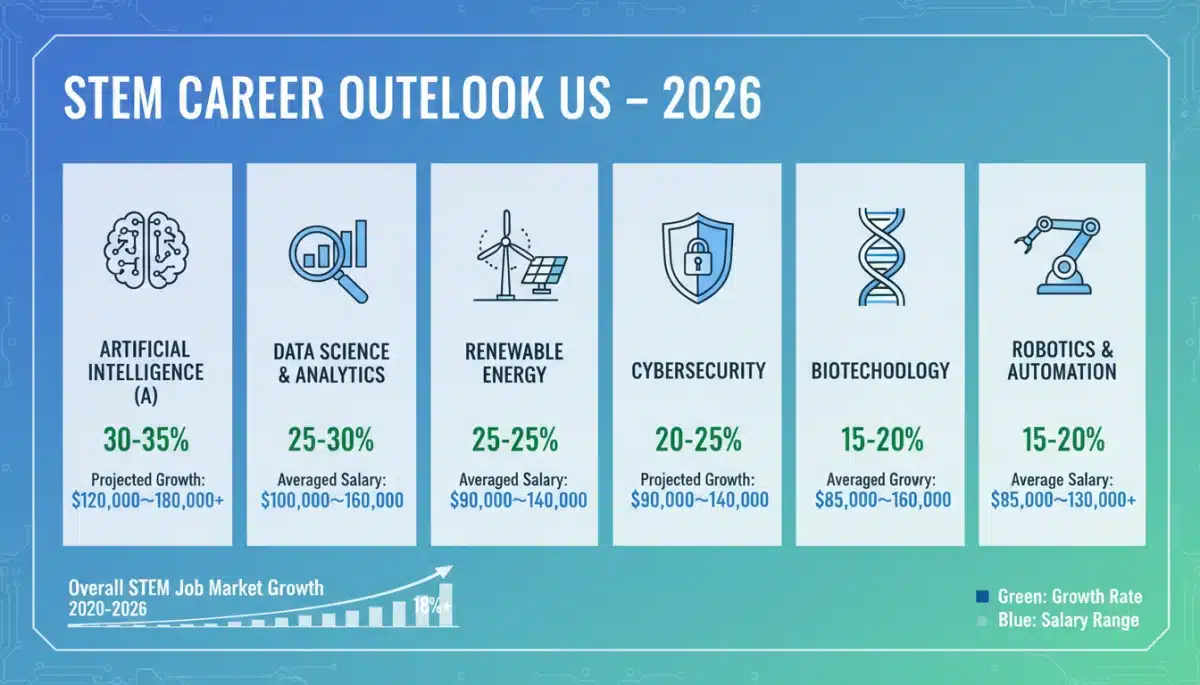
- Artificial Intelligence and Machine Learning: These fields are at the forefront of technological innovation, driving advancements in everything from healthcare to autonomous systems.
- Cybersecurity: With the increasing sophistication of cyber threats, the need for skilled cybersecurity professionals continues to outpace supply.
- Data Science and Analytics: Organizations across all sectors are leveraging vast amounts of data, creating a sustained demand for experts who can interpret and utilize it effectively.
- Biotechnology and Biomedical Engineering: Advances in genetic engineering, personalized medicine, and medical devices are fueling growth in these areas.
The job market will favor those with practical experience, often gained through internships, co-op programs, and project-based learning. Universities are adapting their curricula to meet these demands, offering specialized tracks and certifications that complement traditional degree programs. Therefore, students should research not only the program but also the experiential learning opportunities available.
In conclusion, the 2026 US STEM job market will be characterized by rapid technological advancement and a strong emphasis on specialized, interdisciplinary skills. Understanding these trends is the first step in making an informed decision about your educational path and career trajectory.
Emerging Technologies Driving STEM Career Opportunities
The pace of technological advancement is accelerating, and with it, the types of careers available in STEM are evolving. Several emerging technologies are not just trends but foundational shifts that will define the job market in 2026 and beyond. Aspiring STEM professionals must align their educational choices with these transformative areas to maximize their future career prospects.
These technologies demand a new breed of professionals who are not only technically proficient but also possess critical thinking, problem-solving, and adaptive learning capabilities. The ability to work collaboratively in diverse teams and communicate complex technical concepts to non-technical stakeholders is also increasingly valued.
Artificial Intelligence and Robotics
AI and robotics are no longer confined to research labs; they are integrating into everyday life and industry. This creates a high demand for engineers, researchers, and developers who can design, implement, and maintain AI systems and robotic solutions. From autonomous vehicles to advanced manufacturing, the applications are vast and growing.
- AI Engineers: Developing and deploying machine learning models.
- Robotics Technicians: Installing, maintaining, and troubleshooting robotic systems.
- Machine Learning Scientists: Conducting research to advance AI algorithms.
The ethical implications and societal impact of AI also present opportunities for those interested in policy, ethics, and human-computer interaction. A holistic understanding of these technologies, beyond just their technical aspects, will be highly beneficial.
Quantum Computing and Advanced Materials
While still in nascent stages, quantum computing promises to revolutionize fields like cryptography, drug discovery, and financial modeling. Similarly, advanced materials science is leading to innovations in sustainable energy, aerospace, and electronics. Pursuing programs in these areas positions students at the cutting edge of scientific discovery and technological application.
These fields require a deep understanding of physics, chemistry, and computer science, often demanding graduate-level education. Early entry into these specializations can offer significant long-term career advantages as these technologies mature and become more widely adopted across industries.
In summary, focusing on programs that emphasize emerging technologies like AI, robotics, quantum computing, and advanced materials will provide a strong foundation for a successful and impactful STEM career in the coming years. These fields offer both intellectual challenge and significant professional growth.
In-Demand STEM Skills for 2026 and Beyond
Beyond specific technological knowledge, certain fundamental skills will be universally valuable across all STEM disciplines in 2026. Employers are increasingly seeking candidates who possess a blend of technical expertise and crucial soft skills, recognizing that innovation and effective problem-solving depend on both. Developing these competencies should be a core component of any STEM program selection.
The ability to adapt to new tools and methodologies rapidly is also paramount. The half-life of technical skills is shrinking, meaning that continuous learning and professional development will not be optional but essential for long-term career viability. Programs that foster a growth mindset and emphasize practical application are therefore highly advantageous.
Analytical and Problem-Solving Skills
At the heart of all STEM fields lies the ability to analyze complex data, identify problems, and devise effective solutions. This involves critical thinking, logical reasoning, and a systematic approach to challenges. Programs that offer extensive project work, case studies, and research opportunities are excellent for honing these skills.
- Critical Thinking: Evaluating information objectively and forming reasoned judgments.
- Data Interpretation: Extracting meaningful insights from raw data.
- Systematic Problem Solving: Applying structured approaches to resolve complex issues.
These skills are not just about finding answers but also about asking the right questions, which often requires creativity and an inquisitive mind. Cultivating these abilities early in an academic career will provide a strong foundation for any STEM profession.
Interdisciplinary Collaboration and Communication
Modern scientific and technological challenges rarely fit neatly into a single discipline. Success often hinges on effective collaboration between experts from diverse backgrounds. Therefore, the ability to work in multidisciplinary teams and communicate complex ideas clearly and concisely is highly sought after.
Strong communication skills, both written and verbal, are essential for presenting findings, writing reports, and engaging with colleagues and stakeholders from various fields. Programs that encourage teamwork, presentations, and cross-departmental projects will better prepare students for the collaborative nature of the contemporary STEM workplace.
Ultimately, developing a robust set of analytical, problem-solving, collaborative, and communication skills, alongside technical proficiency, will be crucial for thriving in the 2026 STEM job market. These are the competencies that empower professionals to innovate and lead.
Comparing STEM Programs: Key Considerations for 2026
With numerous STEM programs available, making an informed choice requires a careful comparison of various factors beyond just the degree name. Students in 2026 should evaluate programs based on their curriculum’s relevance, faculty expertise, industry connections, and flexibility to adapt to future changes. A strategic approach to selection ensures a program aligns with both personal aspirations and market demands.
It’s not just about what you study, but how and where you study it. The learning environment, available resources, and the institution’s reputation within specific STEM fields can significantly impact a student’s educational experience and subsequent career launch. Prospective students should conduct thorough research and, if possible, visit campuses or engage with current students and alumni.
Curriculum and Specializations
Examine the program’s course offerings. Does it include modules on emerging technologies like AI, machine learning, data ethics, or sustainable engineering? Are there opportunities for specialization in areas that align with your interests and the projected job market demand? A forward-thinking curriculum is vital.
- Review core courses and elective options.
- Investigate opportunities for interdisciplinary studies or minors.
- Look for capstone projects or research opportunities that provide practical experience.
Programs that offer flexibility in course selection and encourage students to tailor their studies to specific career goals often provide a more personalized and effective learning journey. This adaptability is particularly important in rapidly evolving fields.
Faculty Expertise and Industry Connections
The quality of faculty and their active involvement in research or industry are critical indicators of a program’s strength. Learning from professors who are at the forefront of their fields can provide invaluable insights and networking opportunities. Additionally, strong industry connections can lead to internships, mentorships, and job placements.
Research faculty profiles, their publications, and any industry partnerships the department or university maintains. Universities with robust career services specifically tailored for STEM students can also be a significant advantage, offering guidance on resume building, interview preparation, and job searching.
In conclusion, comparing STEM programs effectively involves a deep dive into curriculum, faculty, and industry ties. Prioritizing these elements will help students select a program that not only educates but also empowers them for success in the competitive 2026 US job market.
Strategic Program Selection for a Competitive Edge
To gain a competitive edge in the 2026 US STEM job market, strategic program selection goes beyond simply choosing a popular field. It involves a nuanced understanding of how to position oneself uniquely, combining academic rigor with practical experience and a keen awareness of future industry needs. This foresight can transform a degree into a powerful career launchpad.
Consider programs that offer co-operative education (co-op) or extensive internship opportunities. These structured experiences provide invaluable real-world exposure, allowing students to apply classroom knowledge, build professional networks, and often lead directly to job offers upon graduation. Such practical engagement is increasingly a differentiator in a crowded job market.
Leveraging Interdisciplinary Programs
The most complex and impactful problems of our time often require solutions that cross traditional disciplinary boundaries. Programs that integrate elements from different STEM fields, or even combine STEM with business, design, or ethics, can produce highly versatile graduates. For instance, a program blending computer science with biology could lead to a career in bioinformatics or computational biology.
- Bioinformatics: Combining biology, computer science, and statistics.
- Computational Neuroscience: Blending neuroscience with computer science and mathematics.
- Engineering Management: Integrating engineering principles with business administration.
These interdisciplinary approaches foster a broader perspective and equip students with a diverse skill set, making them attractive candidates for roles that demand a holistic understanding of complex systems. The ability to speak multiple ‘languages’ across different fields is a significant asset.
Considering Graduate Studies and Certifications
For highly specialized or research-intensive STEM fields, a bachelor’s degree might be just the beginning. Research the career paths associated with your chosen field to determine if a master’s or Ph.D. is commonly required or provides a substantial advantage. Additionally, industry-recognized certifications can validate specific skills and enhance employability.
For example, in cybersecurity, certifications like Certified Information Systems Security Professional (CISSP) or CompTIA Security+ are highly valued. In data science, specialized certifications in machine learning frameworks or cloud platforms can significantly boost a resume. These additional credentials demonstrate a commitment to expertise and continuous learning.
Ultimately, strategic program selection for 2026 involves a thoughtful balance of academic depth, practical application, interdisciplinary exposure, and a clear understanding of potential further educational or certification needs. This comprehensive approach will best prepare students for sustained success.
Navigating Regional Job Markets and Industry Hubs
The US STEM job market is not monolithic; it’s a diverse ecosystem with distinct regional strengths and industry hubs. When Choosing the Right STEM Program in 2026, understanding these geographical nuances can significantly influence career opportunities and lifestyle choices. Different regions specialize in different areas, offering concentrated opportunities for specific STEM fields.
For instance, while Silicon Valley remains a tech powerhouse, other regions are emerging as significant players in biotechnology, renewable energy, or advanced manufacturing. Aligning your program choice with a region that specializes in your desired field can provide invaluable networking opportunities, internships, and a more direct path to employment after graduation.
Tech Hubs and Innovation Clusters
Major metropolitan areas often serve as innovation hubs, attracting companies and talent in specific STEM sectors. Boston, for example, is a leader in biotech and pharmaceuticals, while Seattle has a strong presence in cloud computing and e-commerce. Researching these clusters can help narrow down program choices and potential future employers.
- Silicon Valley (CA): Software, AI, venture capital.
- Boston (MA): Biotech, pharmaceuticals, education.
- Seattle (WA): Cloud computing, e-commerce, aerospace.
- Austin (TX): Semiconductors, tech startups, cybersecurity.
These hubs often boast a high concentration of specialized companies, research institutions, and a vibrant startup culture, providing a rich environment for career growth and professional development. Proximity to these areas during your studies can offer a significant advantage.
Emerging Markets and Remote Work Opportunities
Beyond established hubs, several emerging markets across the US are experiencing significant STEM growth, often driven by lower costs of living and new government or private investments. These areas might offer unique opportunities or a different quality of life. Furthermore, the rise of remote work in STEM means that geographical location might be less restrictive for some roles, opening up a wider range of possibilities.
However, even with remote work, having a strong network and understanding the industry landscape in specific regions can still be beneficial for career advancement. Some roles and industries inherently require on-site presence, especially those involving lab work, manufacturing, or sensitive data handling. Therefore, it’s crucial to assess the nature of your desired career path.
In conclusion, considering regional job markets and industry hubs is a strategic element in selecting a STEM program. This geographical awareness can open doors to specialized opportunities and help tailor your education to the specific demands of your target career environment.
The Role of Soft Skills and Continuous Learning in STEM Careers
While technical prowess is undeniably crucial in STEM, the long-term success of professionals in 2026 and beyond will increasingly hinge on a robust set of soft skills and a commitment to continuous learning. Employers recognize that the ability to collaborate, communicate, and adapt is as vital as coding or engineering expertise. These attributes are often what differentiate a good professional from an exceptional one.
The rapid evolution of technology means that what is cutting-edge today may be obsolete tomorrow. Therefore, the capacity to quickly acquire new knowledge, master new tools, and pivot to new methodologies is not merely an advantage but a necessity for sustained career growth and relevance in any STEM field.
Essential Soft Skills for STEM Professionals
Soft skills are the interpersonal and personal attributes that enable effective interaction and successful performance in the workplace. For STEM professionals, these include more than just teamwork; they encompass leadership, empathy, and creative problem-solving in ambiguous situations. Developing these skills often happens through extracurricular activities, group projects, and real-world challenges.
- Problem-Solving: Approaching complex issues with creativity and persistence.
- Communication: Articulating technical concepts clearly to diverse audiences.
- Teamwork: Collaborating effectively within multidisciplinary groups.
- Adaptability: Quickly learning new technologies and methodologies.
These skills are not innate; they can be cultivated and refined throughout one’s academic and professional journey. Actively seeking opportunities to practice and improve these areas will significantly enhance a STEM professional’s career trajectory.
Embracing Lifelong Learning
The concept of a static career path equipped with a single degree is largely outdated in STEM. Lifelong learning, through online courses, professional certifications, workshops, and advanced degrees, is now a fundamental expectation. Staying current with industry trends and technological advancements is paramount to maintaining a competitive edge.
Many companies now offer internal training programs or tuition reimbursement for employees pursuing further education, recognizing the value of a continuously upskilled workforce. Proactive engagement in learning new programming languages, data analysis techniques, or emerging scientific theories will ensure sustained relevance and open doors to new opportunities.
In conclusion, for those entering STEM fields in 2026, cultivating strong soft skills and embedding a mindset of continuous learning are as important as acquiring technical knowledge. These combined attributes will empower professionals to navigate the dynamic US job market successfully and contribute meaningfully to innovation.
| Key Aspect | Description for 2026 STEM Outlook |
|---|---|
| High-Demand Fields | AI, Cybersecurity, Data Science, Biotech are projected to have significant growth and job openings. |
| Essential Skills | Beyond technical skills, critical thinking, problem-solving, and communication are crucial. |
| Program Selection | Consider curriculum relevance, faculty expertise, industry ties, and experiential learning. |
| Regional Focus | Aligning with regional industry hubs can offer better networking and job opportunities. |
Frequently Asked Questions About STEM Programs in 2026
Fields like artificial intelligence, machine learning, cybersecurity, and biotechnology are projected to experience the most significant growth. Data science and cloud computing also remain highly in-demand, driven by ongoing digital transformation across all industries in the US.
Beyond technical skills, critical thinking, complex problem-solving, adaptability, and strong communication are paramount. Interdisciplinary collaboration and a commitment to continuous learning are also crucial for long-term career success in the evolving STEM landscape.
Research programs thoroughly, considering curriculum relevance to emerging technologies, faculty expertise, and industry connections. Look for opportunities for internships, co-ops, and project-based learning to gain practical experience and build a professional network.
Not for all, but for highly specialized or research-intensive fields like quantum computing or advanced biotech, a master’s or Ph.D. often provides a significant advantage. Industry certifications can also be highly beneficial for validating specific skills at all career levels.
Regional job markets are crucial. Aligning your program choice with an industry hub specializing in your desired field (e.g., biotech in Boston, software in Silicon Valley) can offer better networking, internship opportunities, and a more direct path to employment after graduation.
Conclusion
Navigating the complexities of the 2026 US job market to choose the right STEM program demands foresight, diligent research, and a strategic approach. The landscape is dynamic, shaped by rapid technological advancements and evolving industry needs. Prospective students who prioritize programs offering cutting-edge curricula, practical experience, strong industry ties, and a focus on essential soft skills will be best positioned for success. By understanding the specific demands of emerging fields and regional opportunities, individuals can make informed decisions that pave the way for impactful and rewarding STEM careers, contributing to innovation and progress in the years to come.
Autor