Estate Planning 2026: Navigating Federal Tax Exemption Limits

Estate planning in 2026 requires understanding evolving federal estate tax exemption limits to safeguard your assets and ensure your legacy’s future.
As we approach 2026, the landscape of estate planning in 2026 is set for significant changes, particularly concerning federal estate tax exemption limits. Understanding these shifts is not just for the ultra-wealthy; it’s crucial for anyone looking to protect their legacy and ensure their assets are distributed according to their wishes. This article will guide you through the intricacies of these upcoming changes, offering insights and strategies to navigate the evolving financial environment.
Understanding the Federal Estate Tax Exemption
The federal estate tax is a tax on your right to transfer property at your death. While it only affects a small percentage of estates, its implications for those it does impact can be substantial. The exemption limit is the amount an individual can pass on without incurring federal estate tax.
Historically, these exemption limits have varied significantly, influenced by economic conditions and legislative priorities. For 2026, a major adjustment is on the horizon, largely due to the scheduled expiration of certain provisions from the Tax Cuts and Jobs Act (TCJA) of 2017. This expiration means that, absent new legislation, the exemption amount is set to revert to pre-TCJA levels, adjusted for inflation.
Historical Context of Exemption Limits
To fully grasp the magnitude of the upcoming changes, it’s helpful to look back at the exemption’s trajectory. Over the past few decades, the federal estate tax exemption has seen both dramatic increases and periods of stability. These changes often reflect broader economic policies aimed at stimulating growth or addressing wealth inequality.
- Early 2000s: Exemption amounts were relatively low, affecting a broader range of estates.
- 2010: A brief repeal of the estate tax, followed by reinstatement.
- 2012: The American Taxpayer Relief Act made the exemption permanent at a higher level, indexed for inflation.
- 2017 (TCJA): Significantly increased the exemption, effectively doubling it for individuals.
Understanding this history provides a foundation for anticipating the potential impact of the 2026 adjustments. It underscores the dynamic nature of estate tax laws and the constant need for proactive planning.
The federal estate tax exemption is a critical component of wealth transfer. Its fluctuations demand continuous attention from individuals and their financial advisors to ensure that estate plans remain effective and aligned with current tax laws. The upcoming changes in 2026 present both challenges and opportunities for those prepared to adapt.
The Impending Changes in 2026: What to Expect
The year 2026 marks a pivotal moment for estate planning due to the sunsetting provisions of the Tax Cuts and Jobs Act (TCJA) of 2017. This legislative shift is projected to significantly alter the federal estate tax exemption limits, impacting a broader range of estates than in recent years. Individuals and families need to understand these changes to prepare adequately.
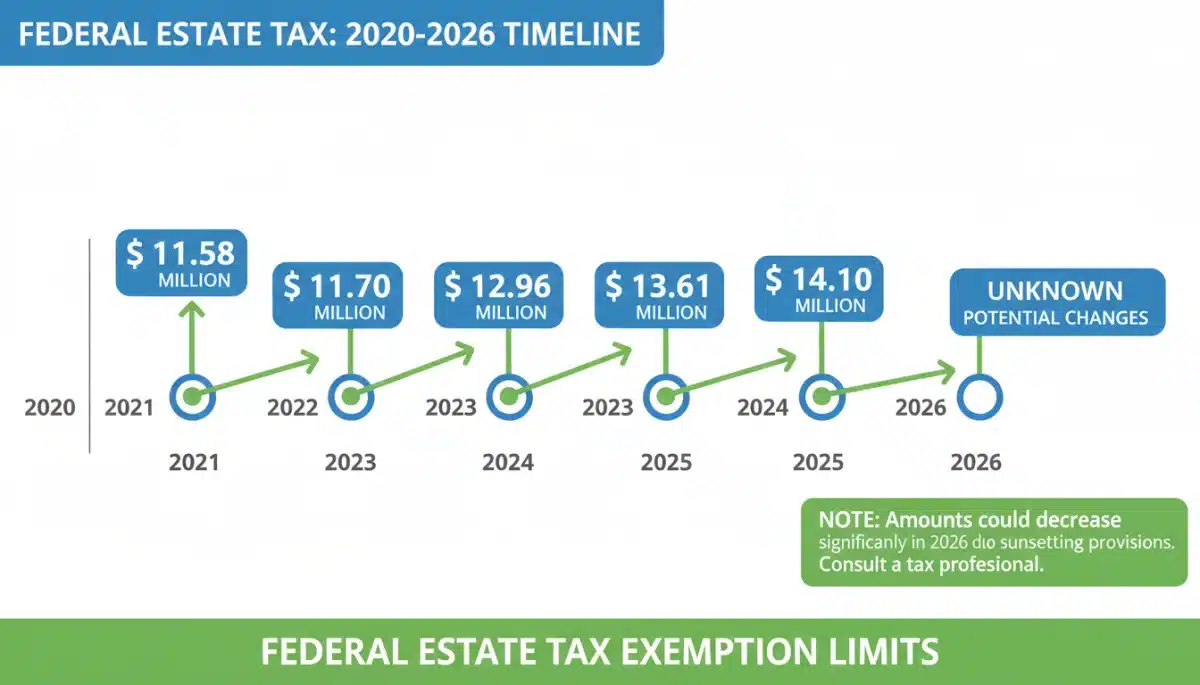
Specifically, the current federal estate tax exemption, which has been historically high, is expected to revert to approximately half its current amount. While the exact figure will be adjusted for inflation, it will likely fall somewhere around $7 million per individual, compared to the over $13 million seen in 2024. This reduction means that more estates will be subject to federal estate tax, making strategic planning more critical than ever.
Impact on High-Net-Worth Individuals
For high-net-worth individuals, the reduction in the exemption limit could mean a substantial increase in potential estate tax liability. This necessitates a thorough review of existing estate plans and a proactive approach to gifting strategies and other wealth transfer mechanisms.
- Increased Tax Exposure: More assets could fall above the exemption threshold, leading to higher tax burdens.
- Urgency in Gifting: Utilizing the higher exemption amounts available before 2026 becomes a priority for some.
- Revisiting Trust Structures: Existing trusts may need modification to adapt to the new exemption levels.
These changes are not merely theoretical; they will have tangible financial consequences. Estate planners and their clients must work collaboratively to forecast these impacts and implement effective mitigation strategies well in advance of the 2026 deadline.
The impending changes in 2026 represent a significant shift in the federal estate tax landscape. Understanding the magnitude of the reduction in exemption limits and its potential impact is the first step toward developing a robust and resilient estate plan that can withstand these legislative adjustments.
Strategies for Navigating Reduced Exemption Limits
With the federal estate tax exemption limits poised to decrease in 2026, proactive planning becomes paramount for individuals seeking to minimize their estate’s tax burden. Several strategies can be employed to navigate these reduced limits effectively, ensuring that your wealth is preserved for future generations.
One of the most immediate and impactful strategies is to utilize the higher exemption amounts available before the 2026 sunset. This involves making significant lifetime gifts to beneficiaries while the current, more generous exemption is still in effect. Such gifts can effectively remove assets from your taxable estate, reducing potential future estate tax liability.

Advanced Gifting and Trust Planning
Beyond simple lifetime gifts, more sophisticated gifting and trust strategies can offer significant advantages. These approaches often involve complex legal structures designed to optimize tax efficiency and provide long-term asset protection.
- Irrevocable Life Insurance Trusts (ILITs): These trusts can hold life insurance policies, removing the death benefit from your taxable estate while providing liquidity for estate taxes.
- Grantor Retained Annuity Trusts (GRATs): GRATs allow you to transfer appreciating assets to beneficiaries with minimal gift tax consequences, especially beneficial in low-interest-rate environments.
- Spousal Lifetime Access Trusts (SLATs): SLATs enable one spouse to make gifts to a trust for the benefit of the other spouse, utilizing their exemption while still providing indirect access to the assets.
These advanced techniques require careful consideration and the guidance of experienced estate planning professionals. The goal is not just to minimize taxes but also to align with your overall financial objectives and family dynamics.
Navigating reduced exemption limits requires a comprehensive approach that combines timely action with sophisticated planning. By exploring gifting opportunities and establishing appropriate trust structures, individuals can significantly mitigate the impact of the 2026 changes on their estate.
The Role of Portability in Estate Planning
Portability is a crucial, yet often misunderstood, element of federal estate tax planning, especially as we approach the 2026 changes. It allows a surviving spouse to use any unused portion of their deceased spouse’s federal estate tax exemption. This provision can significantly increase the total amount an estate can pass tax-free.
Enacted permanently in 2012, portability was designed to provide married couples with greater flexibility in their estate planning. Without portability, if the first spouse to die did not fully utilize their exemption, that unused portion would be lost. With portability, the surviving spouse can add that unused exemption to their own, effectively doubling their combined exemption amount for federal estate tax purposes.
Maximizing Portability Benefits
To effectively utilize portability, several steps and considerations are necessary. It’s not an automatic transfer; the surviving spouse must affirmatively elect portability on a timely filed federal estate tax return (Form 706) for the deceased spouse’s estate.
- Timely Filing: The election must be made within the prescribed timeframe, typically nine months after the date of death, though extensions are possible.
- Professional Guidance: Working with an estate attorney or tax professional is essential to ensure proper filing and to understand the nuances of the election.
- Future Exemption Levels: The portability election locks in the deceased spouse’s unused exemption amount at the time of their death. This can be particularly advantageous if exemption limits are expected to decrease, as is the case in 2026.
While portability offers a powerful tool for married couples, it doesn’t eliminate the need for other estate planning strategies. It complements, rather than replaces, traditional planning techniques like trusts and gifting. Understanding its mechanics and strategic application is vital for optimizing wealth transfer.
Portability is a cornerstone of modern estate planning for married couples, offering a valuable mechanism to maximize federal estate tax exemptions. As 2026 approaches, leveraging portability becomes even more critical for preserving family wealth against potential reductions in individual exemption limits.
State Estate and Inheritance Taxes: A Parallel Consideration
While the federal estate tax exemption limits capture significant attention, especially with the impending 2026 changes, it’s crucial not to overlook the impact of state-level estate and inheritance taxes. These taxes operate independently of federal laws and can significantly affect an estate’s total tax liability, even if it falls below the federal exemption threshold.
Currently, a number of states impose their own estate tax, and some also levy an inheritance tax. An estate tax is levied on the total value of a deceased person’s assets before distribution, similar to the federal tax. An inheritance tax, conversely, is paid by the beneficiaries on the assets they receive. The rules, exemption amounts, and tax rates for these state-level taxes vary widely from state to state.
Navigating State-Specific Regulations
Understanding the specific regulations of your state of residence, and potentially other states where you own property, is a critical component of comprehensive estate planning. What might be an effective strategy at the federal level could have different implications at the state level.
- Residency Considerations: Your legal domicile can determine which state’s estate or inheritance tax laws apply to your entire estate.
- Property Location: Real estate owned in a state with an estate tax, even if you don’t reside there, might be subject to that state’s tax.
- State-Specific Exemptions: Many states have lower exemption thresholds than the federal government, meaning more estates are likely to be impacted.
For example, some states have no estate or inheritance tax, while others have exemptions significantly lower than the federal amount. This disparity underscores the need for localized expert advice. A strategy that works well in Florida (no state estate tax) might be detrimental in New York (which has its own estate tax).
Effective estate planning for 2026 and beyond must encompass both federal and state tax considerations. Ignoring state-level taxes can lead to unexpected liabilities, diminishing the value of the legacy you intend to leave behind. A holistic approach is essential.
The Importance of Regular Estate Plan Reviews
The dynamic nature of tax laws, particularly the federal estate tax exemption limits expected in 2026, underscores the critical importance of regularly reviewing and updating your estate plan. What might have been an effective plan a few years ago could become outdated or even counterproductive due to legislative changes, personal circumstances, or economic shifts.
An estate plan is not a static document; it’s a living framework that needs to evolve with your life. Major life events, such as marriage, divorce, birth of children or grandchildren, significant changes in wealth, or even changes in your health, all warrant a re-evaluation of your existing plan. Without periodic reviews, your plan may no longer accurately reflect your wishes or provide the intended tax efficiencies.
Key Triggers for Reviewing Your Plan
While an annual review is generally recommended, certain events should specifically prompt an immediate re-evaluation of your estate plan. Being proactive can save your beneficiaries significant time, expense, and potential tax burdens.
- Legislative Changes: As with the 2026 federal estate tax exemption changes, new laws can drastically alter the effectiveness of your plan.
- Significant Wealth Changes: A substantial increase or decrease in assets necessitates a review to ensure optimal distribution and tax planning.
- Family Dynamics: Births, deaths, marriages, or divorces within your family can change who your beneficiaries are and how assets should be distributed.
- Executor/Trustee Changes: If your chosen executors or trustees are no longer suitable or able to serve, updates are essential.
Beyond these specific triggers, a comprehensive review allows you to consider new financial products, updated gifting strategies, and evolving charitable giving opportunities. It’s also an opportunity to confirm that your beneficiaries’ contact information is current and that your digital assets are properly addressed.
Regular reviews are the cornerstone of a robust and adaptable estate plan. In a world where financial regulations and personal circumstances are constantly shifting, staying abreast of these changes through consistent plan evaluations ensures your legacy is protected and your wishes are honored.
Preparing for the Future: Actionable Steps for 2026
As 2026 looms with its anticipated changes to federal estate tax exemption limits, taking actionable steps now is crucial for effective estate planning. Procrastination can lead to missed opportunities and increased tax liabilities. A well-thought-out approach can help secure your financial legacy.
The first step is to engage with qualified professionals: an estate planning attorney, a financial advisor, and a tax professional. These experts can provide tailored advice based on your unique financial situation and help you understand how the upcoming changes will specifically impact your estate. Their collective expertise is invaluable in navigating complex tax laws and legal structures.
Immediate Planning Considerations
Beyond professional consultations, several practical steps can be taken immediately to begin preparing your estate for 2026. These actions can lay the groundwork for a more resilient and tax-efficient plan.
- Inventory Your Assets: Create a detailed list of all your assets, including real estate, investments, retirement accounts, and personal property. Understand their current valuations.
- Review Current Documents: Pull out your existing will, trusts, and other estate planning documents. Familiarize yourself with their provisions and identify areas that might need updating.
- Consider Lifetime Gifting: If applicable, explore making gifts under the current higher exemption amounts before they potentially sunset. This can significantly reduce your taxable estate.
- Discuss with Family: Openly communicate your estate planning wishes and strategies with your family. This can prevent misunderstandings and facilitate a smoother transition of assets.
These initial steps, while seemingly straightforward, provide the foundation for more advanced planning strategies. They ensure that you have a clear picture of your current financial standing and what needs to be addressed in light of the 2026 changes.
Preparing for the future of estate planning, especially with the 2026 federal estate tax exemption limits in mind, requires a proactive and informed approach. By taking these actionable steps now, you can position your estate for optimal protection and ensure your legacy endures.
| Key Point | Brief Description |
|---|---|
| 2026 Exemption Changes | Federal estate tax exemption limits are expected to significantly decrease, impacting more estates. |
| Proactive Gifting | Utilize higher current exemption amounts by making lifetime gifts before 2026. |
| Portability’s Role | Surviving spouses can claim unused exemption from a deceased spouse, maximizing tax-free transfers. |
| State Tax Impact | Don’t forget state estate and inheritance taxes, which operate independently of federal laws. |
Frequently Asked Questions About 2026 Estate Planning
The federal estate tax exemption limit is expected to revert to approximately $7 million per individual in 2026, adjusted for inflation, following the sunset of the Tax Cuts and Jobs Act provisions.
The impending reduction makes utilizing the current higher exemption amounts for lifetime gifts before 2026 a crucial strategy to reduce the size of your taxable estate.
Portability allows a surviving spouse to use their deceased spouse’s unused federal estate tax exemption, potentially doubling the amount an estate can pass tax-free, which is vital for maximizing wealth transfer.
You should also consider state-level estate and inheritance taxes. These operate independently and can significantly impact an estate’s total tax liability, even if federal taxes are not owed.
It is recommended to review your estate plan annually, and immediately after significant life events or legislative changes like those expected in 2026, to ensure it remains effective and aligned with your wishes.
Conclusion
The anticipated changes to federal estate tax exemption limits in 2026 present a significant juncture for estate planning. While the prospect of reduced exemptions might seem daunting, it also serves as a powerful catalyst for proactive and strategic financial management. By understanding the nuances of these upcoming shifts, leveraging opportunities for lifetime gifting, utilizing portability, and considering state-specific tax implications, individuals can effectively mitigate potential tax burdens.
Ultimately, a robust estate plan is not a one-time endeavor but an ongoing process that demands regular review and adaptation. Engaging with experienced professionals will be indispensable in navigating this evolving landscape, ensuring your legacy is preserved and your wishes are honored for generations to come. The time to act and refine your estate strategy is now, securing peace of mind for the future.
Autor