Maximize 2026 Social Security Benefits: 10% Payout Boost

Maximizing 2026 Social Security benefits by 10% involves strategic claiming decisions, understanding earnings, and leveraging spousal or survivor options.
Are you ready to truly understand how to maximize your 2026 Social Security benefits? For many, Social Security represents a cornerstone of retirement income, and optimizing your payout can significantly impact your financial well-being. This guide offers practical solutions and insights to potentially boost your benefits by 10% or more, ensuring you make informed decisions for a secure future.
Understanding Social Security Basics for 2026
Before diving into advanced strategies, it’s crucial to grasp the fundamental principles of Social Security as they apply to 2026. The Social Security Administration (SSA) uses a complex formula to calculate benefits, primarily based on your highest 35 years of earnings. These earnings are indexed to account for changes in average wages over time, ensuring that your past earnings reflect their relative value at retirement.
For individuals retiring in 2026, the rules around Full Retirement Age (FRA) remain critical. Your FRA is the age at which you are entitled to 100% of your primary insurance amount (PIA). Claiming benefits before your FRA results in a permanent reduction, while delaying past your FRA can lead to significant increases in your monthly payout, up to age 70. These age-related adjustments are a primary lever for maximizing benefits.
Key Factors Influencing Your Benefit Amount
- Earnings Record: Your 35 highest-earning years determine your Average Indexed Monthly Earnings (AIME), which is then used to calculate your PIA.
- Full Retirement Age (FRA): For those born in 1960 or later, your FRA is 67. Claiming before or after this age has a direct impact on your monthly benefit.
- Cost-of-Living Adjustments (COLAs): Annual COLAs are applied to benefits to help them keep pace with inflation, affecting all beneficiaries.
Understanding these foundational elements is the first step toward developing a robust strategy. Many beneficiaries leave money on the table simply because they are unaware of how these factors interact and how they can be influenced through careful planning. The goal is to proactively manage your claiming decision to align with your financial needs and long-term goals, rather than simply accepting the default.
Strategic Claiming Ages: The Power of Patience
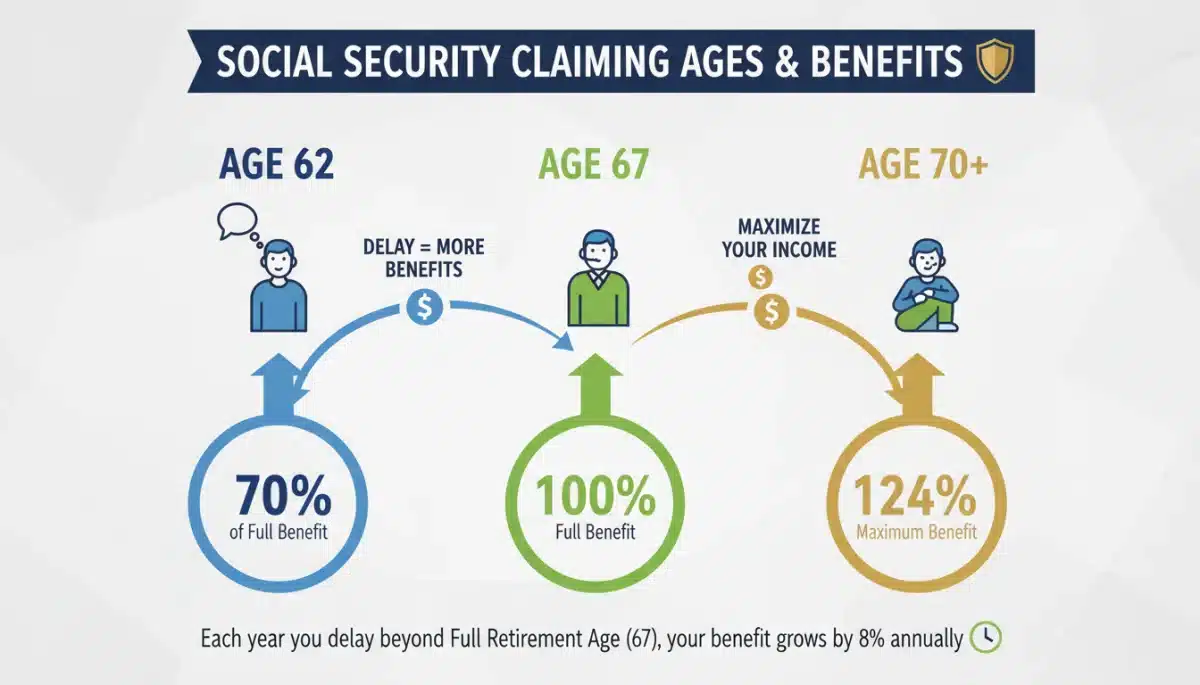
One of the most impactful decisions you’ll make regarding Social Security is when to start claiming your benefits. While you can begin as early as age 62, doing so results in a substantial and permanent reduction in your monthly payment. Conversely, waiting beyond your Full Retirement Age (FRA) can significantly increase your monthly check, providing a powerful boost to your retirement income.
For those reaching FRA in 2026 (born in 1960), delaying benefits until age 70 can result in an 8% increase for each year you wait past your FRA, up to age 70. This translates to a potential 24% increase over your FRA benefit if you delay from age 67 to 70. This guaranteed return on investment is often higher than what you might achieve through other conservative investment vehicles, making it a highly attractive option for many.
Evaluating Your Personal Circumstances
- Health and Longevity: If you anticipate a long lifespan, delaying benefits can yield greater cumulative lifetime payments.
- Current Income Needs: If you have other sources of income to cover expenses in your early retirement years, delaying Social Security becomes more feasible.
- Spousal Benefits: Your claiming decision can also impact your spouse’s benefits, making it a joint financial strategy.
The decision to delay claiming should not be taken lightly. It requires a thorough assessment of your personal health, financial resources, and retirement goals. Consulting with a financial advisor can help you model different scenarios and understand the long-term implications of each claiming age. The objective is to find the sweet spot that balances immediate income needs with the desire for a higher lifetime payout, potentially boosting your annual benefit significantly.
Maximizing Spousal and Survivor Benefits
Social Security isn’t just about your individual earnings record; it also offers valuable benefits for spouses and survivors. Understanding these provisions is crucial for married couples and widows/widowers to maximize their combined household income. These benefits can provide a significant safety net and, when utilized strategically, can contribute to a higher overall payout for the family.
A spouse may be eligible to receive up to 50% of their partner’s Full Retirement Age (FRA) benefit, even if they have little or no earnings history themselves. This can be particularly beneficial for couples where one spouse had significantly higher earnings. For survivor benefits, a widow or widower can receive up to 100% of the deceased spouse’s benefit amount, provided they claim at their own FRA or later. These options present powerful ways to enhance your total Social Security income.
Claiming Strategies for Couples
- File and Suspend (Limited): While largely phased out, understanding its historical context helps appreciate current rules.
- Restricted Application: For those born before January 2, 1954, you might be able to file a restricted application for spousal benefits at your FRA, allowing your own benefit to continue growing.
- Coordinated Delay: Couples can strategically coordinate their claiming ages, often with the higher earner delaying benefits until age 70, to maximize the eventual survivor benefit for the remaining spouse.
Navigating spousal and survivor benefits can be complex, as eligibility rules and claiming options vary based on birth year and current marital status. It’s essential for couples to discuss these strategies together and consider how each decision impacts the other’s financial future. For example, if the higher-earning spouse delays claiming, it not only increases their own benefit but also provides a larger potential survivor benefit for their partner, offering greater financial security for the surviving spouse.
Working While Receiving Benefits: Earnings Limits in 2026
Many individuals choose to continue working even after they begin receiving Social Security benefits. While this can provide additional income, it’s important to be aware of the earnings limits that apply if you are below your Full Retirement Age (FRA). Exceeding these limits can lead to a temporary reduction in your Social Security payments, which are then withheld by the SSA.
For 2026, the specific earnings limits will be announced by the SSA, but typically, if you are under FRA for the entire year, a portion of your benefits will be withheld for every dollar you earn above the limit. In the year you reach FRA, a higher earnings limit applies, and benefits are withheld at a different rate until the month you reach your FRA. Once you reach your FRA, earnings limits no longer apply, and you can earn as much as you want without affecting your benefits.
Understanding the Impact of Earnings Limits
- Benefit Withholding: For every dollar earned above the limit, a certain amount of your Social Security benefit is withheld.
- Future Adjustment: Any benefits withheld due to earnings limits are not lost; they are factored back into your benefit calculation at your FRA, potentially resulting in a higher monthly payment later.
- Strategic Planning: If you plan to work in early retirement, understanding these limits can help you manage your income to avoid or minimize benefit reductions.
Careful planning is essential if you intend to work while claiming benefits before your FRA. It’s not uncommon for individuals to be surprised by benefit reductions because they weren’t fully aware of the earnings limit rules. By understanding these regulations, you can make informed decisions about your work schedule and income, ensuring that your Social Security benefits are maximized rather than inadvertently reduced.
Understanding the Cost-of-Living Adjustments (COLAs)
The Cost-of-Living Adjustment (COLA) is a critical component of Social Security that helps beneficiaries maintain their purchasing power in the face of inflation. Each year, the Social Security Administration (SSA) reviews economic data to determine if an adjustment is necessary. If the cost of living has increased, benefits are adjusted upward to reflect these changes, ensuring that your retirement income doesn’t erode over time.
For 2026, the COLA will be announced in the fall of 2025 and will be based on the Consumer Price Index for Urban Wage Earners and Clerical Workers (CPI-W). This adjustment is applied to all Social Security benefits, including retirement, disability, and survivor benefits. While COLAs are designed to protect against inflation, their size can vary significantly from year to year, depending on economic conditions.
How COLAs Impact Your Long-Term Benefits
- Inflation Protection: COLAs are designed to prevent your benefits from losing value due to rising prices.
- Cumulative Effect: Even small annual COLAs can have a significant cumulative impact on your total lifetime benefits, especially over a long retirement.
- Planning for the Future: While COLAs are not guaranteed to be large every year, they provide a crucial layer of financial security that should be considered in your retirement planning.
The presence of COLAs means that your Social Security benefits are not stagnant; they are designed to adapt to economic realities. While you cannot directly control the COLA percentage, understanding its mechanism helps you appreciate the long-term value of your benefits. It reinforces the importance of maximizing your initial benefit amount, as future COLAs will then be applied to a higher base, further amplifying your payout over time.
Advanced Strategies for a 10% Payout Boost
Achieving a 10% or greater boost in your Social Security payout often requires a combination of the strategies discussed and a deep understanding of your personal circumstances. It’s not about finding a single trick, but rather optimizing multiple factors to work in your favor. This holistic approach can yield substantial financial benefits over your retirement years.
One key advanced strategy involves coordinating claiming ages within a married couple. For instance, the higher-earning spouse might delay claiming until age 70 to maximize their benefit, which also maximizes the potential survivor benefit for their spouse. The lower-earning spouse might claim earlier, say at their FRA, to provide some income during the delay period, or they might also delay if other income sources are sufficient.
Practical Steps to Increase Your Payout
- Review Your Earnings Record: Regularly check your Social Security statement for accuracy. Correcting errors can increase your AIME.
- Work Longer if Possible: Replacing low-earning years with higher-earning years can boost your average indexed monthly earnings.
- Consider Tax Implications: Understand how Social Security benefits are taxed and plan your retirement income streams to minimize tax liabilities.
Another often-overlooked strategy is to ensure you have at least 35 years of earnings. If you have fewer than 35 years, zero-earning years will be averaged into your calculation, significantly reducing your overall benefit. Working a few extra years to replace those zeros with positive earnings can have a surprisingly large impact on your final benefit amount. By combining these practical steps, you can actively work towards a substantial increase in your 2026 Social Security benefits.
| Key Strategy | Brief Description |
|---|---|
| Delay Claiming Age | Waiting past your Full Retirement Age (FRA) up to age 70 increases monthly benefits by 8% annually. |
| Optimize Spousal Benefits | Married couples can coordinate claiming to maximize combined household benefits or survivor payouts. |
| Review Earnings Record | Ensure your 35 highest earning years are accurately recorded; correct any errors to boost your AIME. |
| Work Longer | Replacing low or zero-earning years with higher income years can significantly increase your average earnings. |
Frequently Asked Questions About 2026 Social Security Benefits
For individuals born in 1960, who will reach age 66 in 2026, their Full Retirement Age (FRA) is 67. This means that if they claim benefits at 67, they will receive 100% of their primary insurance amount.
For each year you delay claiming Social Security benefits past your Full Retirement Age (FRA) up to age 70, your monthly benefit increases by approximately 8%. This delayed retirement credit can lead to a significantly higher monthly check.
Yes, if you are below your Full Retirement Age (FRA) and earn above certain limits, a portion of your Social Security benefits may be withheld. Once you reach your FRA, earnings limits no longer apply, and you can earn any amount.
Yes, a spouse may be eligible to receive up to 50% of their partner’s Full Retirement Age (FRA) benefit, even if they have a limited work history. Strategic claiming by couples can maximize household benefits.
Cost-of-Living Adjustments (COLAs) help Social Security benefits keep pace with inflation. While you can’t control the COLA percentage, maximizing your initial benefit amount means future COLAs are applied to a larger base, further increasing your payout.
Conclusion
Maximizing your 2026 Social Security benefits is not a matter of luck but rather a result of informed planning and strategic decision-making. By carefully considering your claiming age, understanding spousal and survivor benefits, being aware of earnings limits, and staying informed about COLAs, you can significantly boost your retirement income. These practical solutions and their financial impact underscore the importance of taking an active role in optimizing your Social Security payout, ensuring a more secure and comfortable retirement.
Autor