Gig Economy Growth: 45% U.S. Workforce by 2030 Report

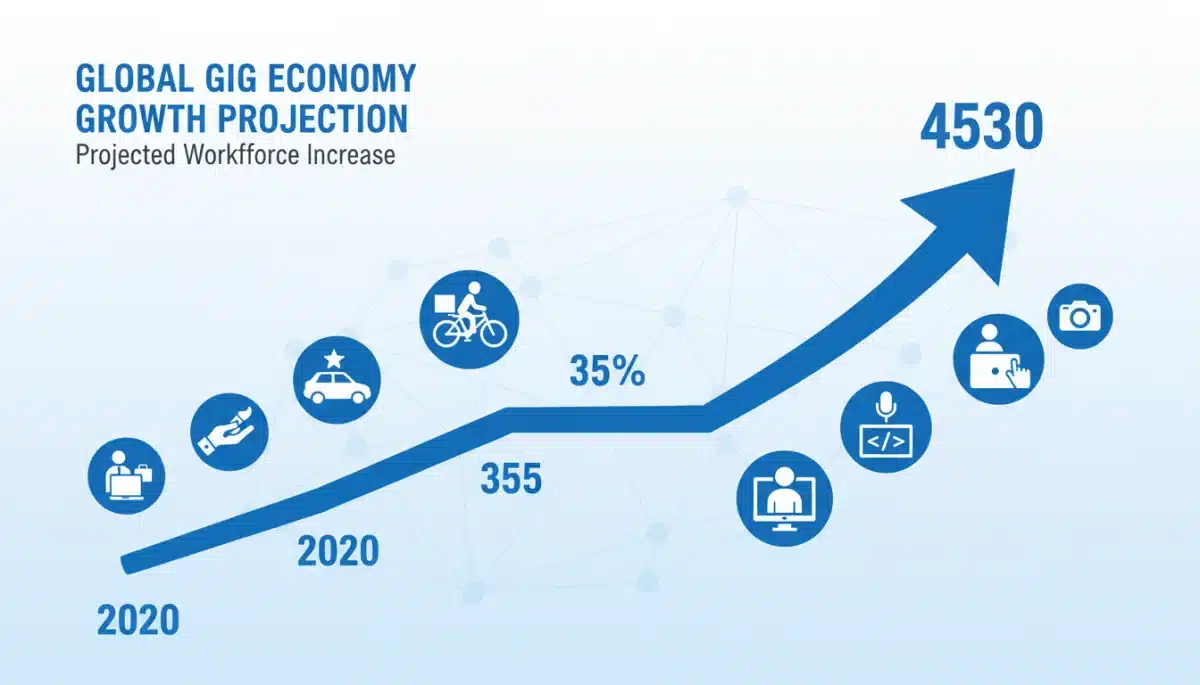
A new federal report projects the gig economy growth will reach 45% of the U.S. workforce by 2030, indicating a monumental shift in employment landscapes.
The landscape of work in America is undergoing a profound transformation, with a new federal report casting a compelling light on the future of work: gig economy growth projected to reach 45% of U.S. workforce by 2030, according to new federal report. This isn’t just a fleeting trend; it’s a fundamental reshaping of how individuals earn a living and how businesses operate. What does this dramatic shift mean for you, for the economy, and for society as a whole?
Understanding the Gig Economy Phenomenon
The gig economy, characterized by temporary, flexible jobs where individuals work as independent contractors or freelancers rather than permanent employees, has been steadily expanding. This model offers both opportunities and challenges, influencing everything from urban planning to social safety nets. Its rapid acceleration necessitates a closer look at its underlying drivers and potential impacts.
Historically, the concept of temporary work isn’t new, but the digital age has amplified its reach and accessibility. Platforms connecting workers to tasks have streamlined the process, making it easier than ever for individuals to find short-term engagements and for companies to access specialized skills on demand. This technological leap is a primary catalyst for the current surge.
Defining the Gig Worker
Who exactly constitutes a gig worker? It’s a broad category, encompassing a wide range of professions and skill levels. From rideshare drivers and food delivery couriers to freelance graphic designers, consultants, and software developers, the diversity is immense. What unites them is the contractual, project-based nature of their employment, often facilitated by digital platforms.
- Independent Contractors: Individuals providing services to multiple clients without being an employee of any single one.
- Freelancers: Professionals offering specialized skills on a project-by-project basis.
- Platform Workers: Those who find work primarily through online platforms that connect them with consumers or businesses.
Understanding these distinctions is crucial for policymakers and economists alike, as each category faces unique regulatory and economic considerations. The report’s projection underscores the need for comprehensive frameworks that address the evolving nature of this workforce.
In conclusion, the gig economy is not a monolithic entity but a complex ecosystem of diverse work arrangements. Its growth is driven by technological innovation and a shifting preference for flexibility, demanding a nuanced understanding to navigate its future effectively.
Key Drivers Behind the Projected 45% Growth
Several significant factors are converging to propel the gig economy towards becoming nearly half of the U.S. workforce. These drivers reflect both societal shifts and technological advancements, creating a fertile ground for flexible work models. Examining these forces provides critical insight into the future labor market.
The allure of autonomy and flexibility is a powerful draw for many. Traditional 9-to-5 jobs often come with rigid schedules and limited control over one’s work environment. Gig work, by contrast, offers the freedom to set one’s own hours, choose projects, and work from virtually anywhere, appealing to a growing segment of the population seeking a better work-life balance.
Technological Advancements and Platform Proliferation
The proliferation of digital platforms has been instrumental in democratizing access to gig work. These platforms act as intermediaries, efficiently connecting service providers with clients. Mobile applications, in particular, have made it incredibly easy for individuals to find and undertake tasks, from driving passengers to delivering groceries, with just a few taps.
- Algorithmic Matching: Efficiently connects workers with suitable tasks, optimizing resource allocation.
- Reduced Transaction Costs: Platforms lower the barriers for entry for both workers and clients, making gig work more accessible.
- Global Reach: Digital tools enable freelancers to find clients beyond geographical limitations, expanding opportunities.
This technological infrastructure not only facilitates gig work but also continuously innovates, introducing new services and expanding the scope of what can be offered on a freelance basis. The ease of entry and operation offered by these platforms is a major catalyst.
Beyond technology, economic pressures and a desire for supplemental income also play a role. Many individuals turn to gig work to supplement their primary income, cover unexpected expenses, or navigate periods of unemployment. The accessibility of these jobs provides a crucial financial safety net for many households across the U.S.
In summary, the projected growth of the gig economy is a multifaceted phenomenon, fueled by a combination of technological innovation, the desire for flexibility, and evolving economic realities. These drivers are fundamentally reshaping employment paradigms.
Implications for Workers: Opportunities and Challenges
The rapid expansion of the gig economy presents a dual-edged sword for workers, offering unprecedented opportunities for flexibility and diverse income streams, while simultaneously introducing new challenges related to stability and benefits. Navigating this evolving landscape requires a clear understanding of both its advantages and disadvantages.
For many, the appeal of gig work lies in its inherent flexibility. The ability to choose when, where, and how much to work empowers individuals to better manage personal responsibilities, pursue creative passions, or simply avoid the constraints of a traditional office environment. This autonomy is a powerful motivator, particularly for those seeking alternatives to conventional employment structures.
The Promise of Flexibility and Autonomy
Gig work often allows individuals to be their own boss, fostering a sense of entrepreneurship and control over their professional lives. This can lead to greater job satisfaction for those who thrive in independent settings. Furthermore, the diverse range of available tasks means workers can continuously develop new skills and explore different industries without long-term commitments.
However, this freedom comes with significant trade-offs. The lack of traditional employee benefits, such as health insurance, paid time off, and retirement plans, is a major concern. Gig workers are typically responsible for their own benefits, which can be a substantial financial burden, especially in a country like the U.S. where healthcare costs are high.
Navigating Income Instability and Lack of Benefits
Income instability is another prominent challenge. The unpredictable nature of gig assignments can lead to fluctuating earnings, making financial planning difficult. Workers may experience periods of high demand followed by lulls, requiring careful budgeting and savings strategies. The absence of unemployment benefits further exacerbates this vulnerability.
- Financial Planning: Essential due to unpredictable income streams.
- Benefit Gaps: Workers must independently secure health insurance, retirement, and other critical benefits.
- Worker Protections: Limited access to protections afforded to traditional employees, such as minimum wage and anti-discrimination laws.
The conversation around worker protections and benefits for gig laborers is ongoing, with policymakers exploring various models to provide a more robust safety net without stifling the innovation and flexibility that define the gig economy. Solutions could range from portable benefits to new classifications of employment.
In conclusion, while the gig economy offers appealing flexibility and autonomy, it also presents substantial challenges related to financial stability and access to essential benefits. Addressing these issues will be paramount to ensuring a sustainable and equitable future for gig workers.
Impact on Businesses: Agility and Talent Access
For businesses, the burgeoning gig economy represents a paradigm shift in talent acquisition and operational agility. The ability to tap into a vast pool of specialized skills on demand, without the overheads associated with full-time employment, offers significant strategic advantages. This model allows companies to scale operations up or down rapidly in response to market fluctuations.
One of the most compelling benefits for businesses is the unprecedented access to a diverse talent pool. Companies are no longer confined to local hiring markets; they can engage skilled professionals from across the country, or even globally, for specific projects. This broadens their options and allows them to find the best fit for specialized tasks, enhancing overall project quality and innovation.
Enhanced Operational Flexibility and Cost Efficiency
Engaging gig workers can lead to considerable cost savings for businesses. By utilizing independent contractors, companies can reduce expenses related to employee benefits, payroll taxes, office space, and training. This lean operational model is particularly attractive for startups and small to medium-sized enterprises (SMEs) looking to maximize efficiency and minimize fixed costs.
- Reduced Overhead: Lower costs associated with benefits, taxes, and physical infrastructure.
- Scalability: Easily adjust workforce size based on project demand or seasonal fluctuations.
- Specialized Expertise: Access to niche skills without the commitment of a full-time hire.
Moreover, the gig model fosters greater organizational agility. Businesses can quickly assemble teams for specific projects, dissolve them upon completion, and reconfigure for new initiatives. This responsiveness is vital in today’s fast-paced market, enabling companies to adapt to changing consumer demands and technological advancements more effectively.
However, challenges also exist. Managing a distributed workforce of independent contractors requires robust communication strategies and clear contractual agreements to ensure project success and compliance. Businesses must also navigate the legal complexities surrounding worker classification to avoid misclassification penalties.
In summary, the gig economy provides businesses with unparalleled flexibility and access to talent, driving cost efficiencies and fostering agility. Effectively managing this workforce, however, requires careful planning and adherence to legal guidelines to fully realize its potential benefits.
Regulatory Landscape and Policy Responses
As the gig economy continues its exponential growth, the regulatory landscape is struggling to keep pace, leading to a complex interplay of legal challenges and policy debates. Governments at federal, state, and local levels are grappling with how to classify gig workers, ensure fair labor practices, and provide adequate social safety nets without stifling innovation. This evolving environment demands thoughtful and adaptive policy responses.
A central issue revolves around worker classification: are gig workers employees or independent contractors? This distinction has profound implications for minimum wage laws, overtime pay, collective bargaining rights, and access to benefits. Misclassification can result in significant legal liabilities for companies and deprive workers of essential protections.
The Debate Over Worker Classification
Various jurisdictions have attempted to address worker classification through legislation, with mixed results. California’s AB5, for instance, sought to reclassify many gig workers as employees, sparking considerable controversy and legal battles. The outcomes of such legislative efforts highlight the difficulty in fitting novel work arrangements into existing legal frameworks designed for traditional employment.
- Employee Status: Entitles workers to minimum wage, overtime, and benefits.
- Independent Contractor Status: Offers flexibility but fewer legal protections and benefits.
- Hybrid Models: Proposals for new worker categories that blend aspects of both statuses.
Beyond classification, policymakers are also exploring mechanisms to provide gig workers with portable benefits, allowing them to carry health insurance, retirement savings, and other protections from one gig to another. This approach aims to address the benefit gap without forcing a traditional employer-employee relationship.
The federal report’s projection of 45% gig workforce by 2030 will undoubtedly intensify these discussions, pushing for more comprehensive and unified policy solutions. The goal is to create a regulatory environment that supports the flexibility of the gig economy while ensuring equitable treatment and security for workers.
Ultimately, the regulatory response to the gig economy is a critical determinant of its future trajectory. Crafting policies that balance innovation with worker protection will be key to harnessing the full potential of this evolving work model.
The Societal and Economic Shifts Ahead
The projected expansion of the gig economy to nearly half of the U.S. workforce by 2030 signals profound societal and economic shifts that extend far beyond individual employment contracts. This transformation will impact everything from urban infrastructure and consumer behavior to social safety nets and the very definition of a career. Understanding these broader implications is essential for proactive planning.
Economically, a larger gig workforce could lead to increased economic dynamism and innovation, as businesses gain greater flexibility and access to specialized talent. However, it also raises questions about wealth distribution, income inequality, and the stability of consumer spending if a significant portion of the population faces unpredictable earnings.
Redefining Career Paths and Social Structures
The traditional linear career path, often characterized by long-term employment with a single company, is becoming less common. The gig economy encourages a portfolio career approach, where individuals piece together multiple income streams and projects, building a diverse skill set. This redefinition of ‘career’ requires new educational and training models to prepare future workers.
Socially, the rise of independent work could alter community structures. With fewer people commuting to central offices, there might be shifts in urban development, with a greater emphasis on co-working spaces and local amenities. The sense of belonging and camaraderie often found in traditional workplaces might also need new avenues for fostering connections among gig workers.
- Education Reform: Curricula must adapt to foster entrepreneurial skills and adaptability for gig work.
- Urban Planning: Increased demand for flexible workspaces and mixed-use developments.
- Social Cohesion: New models needed to support community and professional networking among independent workers.
Furthermore, the implications for social safety nets are immense. The current system is largely built around traditional employer-employee relationships. A workforce dominated by independent contractors will necessitate a rethinking of how healthcare, unemployment insurance, and retirement benefits are funded and administered to ensure universal access.
In conclusion, the growth of the gig economy is not merely a change in employment type but a fundamental societal and economic evolution. Addressing its wide-ranging implications will require collaborative efforts from governments, businesses, and educational institutions to build a resilient and equitable future of work.
Preparing for the Gig-Dominated Future
With the federal report projecting that the gig economy will constitute 45% of the U.S. workforce by 2030, proactive preparation is no longer an option but a necessity. This preparation must span individuals, businesses, and policymakers, focusing on adaptability, skill development, and robust support systems. The goal is to harness the benefits of flexibility while mitigating the inherent risks.
For individuals, cultivating a mindset of continuous learning and skill acquisition is paramount. The gig economy rewards adaptability and specialized expertise, making ongoing professional development crucial. Building a strong personal brand and professional network will also become increasingly vital for securing consistent work.
Strategies for Individuals and Businesses
Individuals should focus on diversifying their skill sets, understanding market demands, and developing strong financial literacy to manage unpredictable income. Exploring portable benefits options and contributing to personal retirement accounts should also be prioritized. The emphasis shifts from job security to skill security.
Businesses, on their part, need to develop sophisticated strategies for integrating gig workers into their operations. This includes clear onboarding processes, effective communication channels, and fair compensation models. Investing in platforms that streamline gig worker management and ensuring legal compliance regarding classification are also critical.
- Individual Adaptability: Continuous learning, skill diversification, and financial planning.
- Business Integration: Effective management, fair practices, and legal compliance for gig workers.
- Policy Innovation: Developing portable benefits and new worker classifications.
Policymakers face the challenging task of creating regulatory frameworks that support innovation while providing adequate protections for gig workers. This could involve establishing new categories of employment, developing universal benefit programs, or fostering collective bargaining opportunities for independent contractors. Collaborative efforts between all stakeholders will be essential.
The transition to a gig-dominated future will not be without its hurdles, but with thoughtful planning and adaptive strategies, the U.S. can leverage the dynamism of this new work model. The focus must be on creating an ecosystem where both workers and businesses can thrive in an increasingly flexible labor market.
In conclusion, preparing for a future where the gig economy is a dominant force requires a multi-faceted approach. Individuals, businesses, and governments must all adapt and innovate to ensure a resilient, equitable, and prosperous working landscape for 2030 and beyond.
| Key Point | Brief Description |
|---|---|
| Projected Growth | Gig economy expected to reach 45% of U.S. workforce by 2030, per federal report. |
| Worker Implications | Offers flexibility but raises concerns about benefits, income stability, and worker protections. |
| Business Advantages | Provides agility, cost efficiency, and access to a diverse, on-demand talent pool. |
| Regulatory Challenges | Policymakers grapple with worker classification and establishing portable benefits. |
Frequently Asked Questions About the Gig Economy’s Future
A recent federal report projects that the gig economy will comprise 45% of the U.S. workforce by 2030. This significant increase signals a major shift in traditional employment models, driven by technological advancements and evolving worker preferences for flexibility and autonomy.
For individuals, gig work offers unparalleled flexibility in scheduling, autonomy over projects, and the ability to work from various locations. It allows workers to pursue diverse income streams, develop new skills, and potentially achieve a better work-life balance compared to traditional employment structures.
Gig workers often face challenges such as income instability due to unpredictable work availability, lack of traditional employee benefits like health insurance and retirement plans, and limited access to worker protections afforded to full-time employees. Financial planning and self-provision of benefits become crucial responsibilities.
Businesses benefit from the gig economy through increased operational flexibility, reduced overhead costs, and access to a vast, specialized talent pool on demand. This model allows companies to scale their workforce quickly, respond to market changes efficiently, and tap into niche expertise without long-term commitments.
Policymakers are exploring various responses, including new worker classification models that blend employee and contractor statuses, and the development of portable benefits systems. The aim is to provide gig workers with better protections and benefits while preserving the flexibility that defines the gig economy.
Conclusion
The federal report’s projection of the gig economy encompassing 45% of the U.S. workforce by 2030 is a clear signal of an irreversible shift in the world of work. This transformation brings both immense opportunities for flexibility and innovation, alongside significant challenges related to worker security and regulatory adaptation. Navigating this future successfully will require a concerted effort from individuals, businesses, and policymakers to foster an environment that is both dynamic and equitable. By embracing continuous learning, developing adaptive business strategies, and crafting forward-thinking policies, the U.S. can effectively prepare for a gig-dominated labor landscape, ensuring prosperity and stability for all.
Autor