2026 Standardized Testing Changes: US College Admissions Updates

The 2026 standardized testing changes for US college admissions introduce significant updates to exam formats and acceptance policies, requiring students to adapt their preparation strategies for a competitive application landscape.
Are you a high school student, parent, or educator wondering how the landscape of college admissions will shift in the near future? The year 2026 brings pivotal modifications to standardized testing, and understanding the 2026 standardized testing changes for US college admissions is crucial for anyone navigating this complex process.
The evolving role of standardized tests in admissions
Standardized tests like the SAT and ACT have long been cornerstones of the US college admissions process, serving as a common metric to evaluate applicants from diverse educational backgrounds. However, their role has been continuously debated and redefined, particularly in recent years. The 2026 changes represent a significant chapter in this ongoing evolution, reflecting broader discussions about equity, accessibility, and the holistic review of applicants.
Historically, these tests were seen as essential predictors of college success, providing a quantitative measure that could be compared across different high school curricula. Yet, concerns about socioeconomic biases, test anxiety, and whether a single score truly captures a student’s potential have led to widespread reevaluation. Many institutions temporarily adopted test-optional policies during the pandemic, and some are now making these policies permanent, while others are reintroducing requirements with new considerations.
Shifting institutional perspectives
Colleges and universities are increasingly looking beyond mere test scores to assess applicants. This shift is driven by a desire to admit a more diverse student body and to recognize a wider range of talents and experiences. While scores remain important for some institutions, their weight in the overall application package is often being recalibrated.
- Holistic review processes gaining prominence.
- Emphasis on essays, extracurriculars, and recommendations.
- Consideration of socioeconomic context in application review.
The evolving role of standardized tests means that applicants must present a well-rounded profile, where test scores, if submitted, complement other strong aspects of their application. It’s no longer solely about achieving a high score, but about how that score fits into a compelling personal narrative.
In conclusion, the function of standardized tests in college admissions is undergoing a profound transformation. While they retain some importance, their dominance is waning, replaced by a more comprehensive evaluation that seeks to understand each applicant’s unique strengths and potential contributions to the university community. This recalibration is central to understanding the 2026 changes.
Key modifications to SAT and ACT formats
The College Board and ACT, Inc. are not static entities; they continually adapt their exams to remain relevant and effective. The 2026 standardized testing changes include notable modifications to the formats of both the SAT and ACT, designed to better align with modern educational practices and to enhance the testing experience for students. These changes reflect a move towards digital platforms and a focus on assessing skills deemed critical for success in higher education.
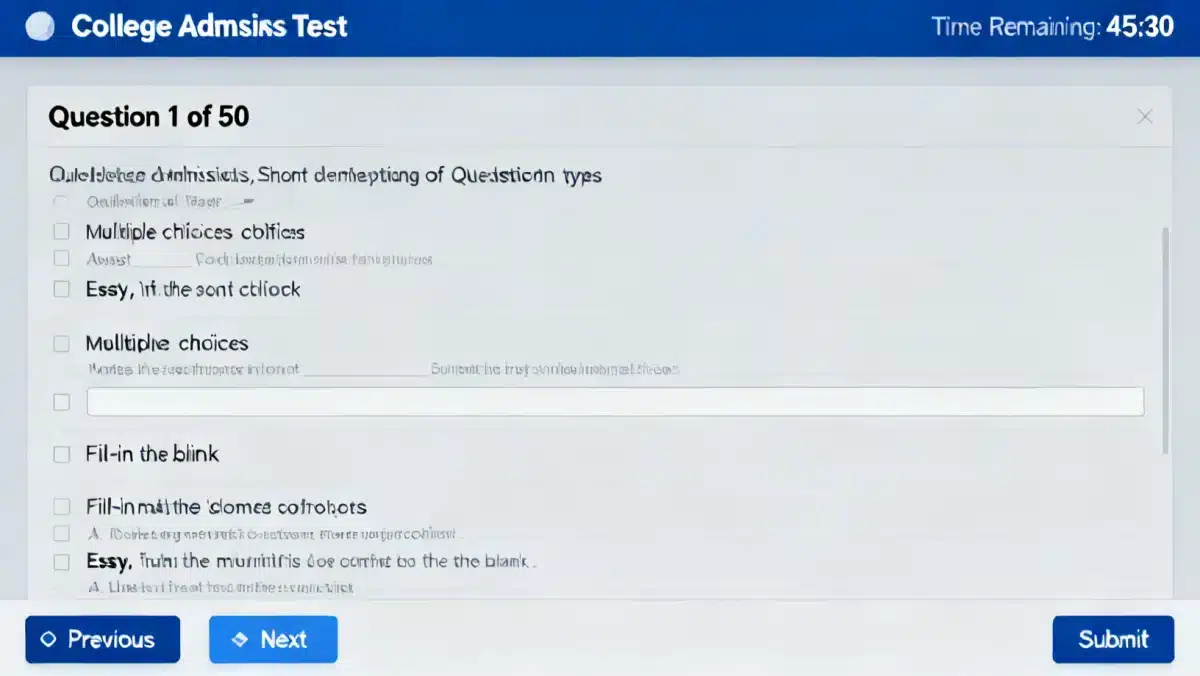
One of the most significant shifts is the move towards digital testing. This transition aims to improve accessibility, streamline administration, and potentially offer more dynamic question types. For students, this means familiarizing themselves with a new testing environment and potentially different pacing strategies than traditional paper-and-pencil exams.
The digital SAT experience
The digital SAT, which began its rollout in international markets in 2023 and will be fully implemented in the U.S. by spring 2024, introduces several key differences that will be fully in effect by 2026. These changes are designed to make the test more efficient and student-friendly.
- Shorter test duration, approximately two hours instead of three.
- Adaptive testing format, adjusting difficulty based on performance.
- Built-in graphing calculator for the math section.
- Shorter reading passages, with one question per passage.
These modifications aim to reduce test fatigue and provide a more precise measure of student ability. The adaptive nature of the test means that each student’s experience will be somewhat personalized, potentially leading to a more accurate score. Understanding these structural changes is vital for effective preparation.
Similarly, the ACT is also exploring and implementing digital options and other adjustments to its format. While the core content areas largely remain the same, the presentation and interaction with the test may evolve. Students should stay updated on specific announcements from ACT, Inc. regarding any further modifications by 2026.
In summary, both the SAT and ACT are undergoing significant format changes, with a strong emphasis on digital delivery and adaptive testing. These updates are intended to create a more efficient and relevant assessment experience, and prospective college applicants must be aware of these modifications to prepare effectively for the 2026 college admissions cycle.
Impact on specific college admissions policies
The 2026 standardized testing changes are not just about the tests themselves; they profoundly influence how colleges formulate and execute their admissions policies. As test formats evolve and the broader conversation around equity continues, institutions are revisiting their stances on requiring, recommending, or making tests optional. This presents a complex and varied landscape for applicants, requiring careful research into each prospective college’s specific requirements.
Many universities are moving towards a more nuanced approach, recognizing that a single policy might not serve all students or accurately reflect their institutional values. This means that while some highly selective institutions might reaffirm test requirements, others might embrace test-optional or even test-blind policies with greater conviction. The flexibility within these policies is a defining characteristic of the 2026 admissions cycle.
Test-optional versus test-blind policies
Understanding the distinction between test-optional and test-blind policies is paramount for applicants. A test-optional policy means students can choose whether or not to submit their scores, with no penalty for not doing so. Test-blind, on the other hand, means the institution will not consider test scores at all, even if submitted.
- Test-optional: Scores can be submitted but are not required. Often used to broaden applicant pools.
- Test-blind: Scores are not considered in the admissions decision, regardless of submission.
- Test-preferred: Some institutions may indicate a preference for scores, even if not strictly required.
Colleges are also experimenting with different ways to use test scores when they are submitted. For instance, some might use them primarily for scholarship consideration or placement in advanced courses, rather than as a primary factor in the initial admission decision. This nuanced approach highlights the need for students to thoroughly investigate each college’s specific guidelines well in advance of application deadlines.
Furthermore, institutions are increasingly emphasizing the context of an applicant’s scores. A score achieved by a student from an under-resourced school might be viewed differently than the same score from a student with access to extensive test preparation resources. This contextual review aims to level the playing field and ensure a fairer assessment of potential.
In conclusion, the impact of the 2026 standardized testing changes on college admissions policies is characterized by diversity and nuance. Applicants must meticulously research the individual requirements of each university, understanding the subtle differences between test-optional, test-blind, and other emerging policies to strategize their applications effectively.
Strategies for students to prepare effectively
Given the significant 2026 standardized testing changes, students need to adopt dynamic and informed preparation strategies. The transition to digital formats and evolving college policies mean that traditional study methods may need to be adapted. Effective preparation now involves understanding the new test structures, leveraging available digital resources, and making strategic decisions about when and if to submit scores.
Successful preparation begins with early planning. Students should identify their target colleges and thoroughly research their specific testing policies for the 2026 cycle. This proactive approach will help determine whether a test is required, optional, or not considered at all, thereby guiding the intensity and focus of their test preparation efforts.
Leveraging digital resources and practice tests
With the shift to digital exams, becoming proficient with the online testing environment is as important as mastering the content. Both the College Board and ACT, Inc. are expected to provide official digital practice tests and resources, which should be the primary tools for preparation.
- Utilize official digital practice tests to familiarize with the interface.
- Focus on understanding the adaptive nature of the digital SAT.
- Practice time management in a digital setting, including breaks.
- Explore online tutorials and webinars offered by testing organizations.
Beyond official resources, students can also benefit from online courses, tutoring, and various educational apps designed to simulate the digital testing experience. It is crucial to choose resources that are updated to reflect the latest 2026 test formats and content.
Furthermore, students should not solely rely on test scores. A holistic application, including strong academic performance, compelling essays, meaningful extracurricular activities, and insightful letters of recommendation, remains crucial. Test preparation should complement, not overshadow, these other vital components of a college application.
In conclusion, effective preparation for the 2026 standardized testing changes requires a multi-faceted approach. Students must adapt to digital formats, utilize official practice materials, and strategically plan their testing schedule in alignment with college-specific policies. This comprehensive strategy will empower them to present their best selves in the competitive admissions landscape.
The debate: fairness, equity, and accessibility
The ongoing discourse surrounding standardized testing has always been deeply intertwined with questions of fairness, equity, and accessibility. The 2026 standardized testing changes are occurring within a broader context where these issues are at the forefront of educational policy discussions. Critics argue that traditional standardized tests often disadvantage students from lower socioeconomic backgrounds, minority groups, and those with learning differences, perpetuating existing inequalities.
Proponents, however, maintain that standardized tests offer a common, objective measure that can highlight talent regardless of the quality of a student’s high school. They argue that without these tests, admissions committees might rely more heavily on subjective measures, potentially introducing other forms of bias. The move towards digital testing also brings its own set of accessibility challenges and opportunities.
Addressing digital divide and accommodations
The transition to digital exams, while offering some benefits, also raises concerns about the digital divide. Not all students have equal access to reliable internet, up-to-date devices, or a quiet, conducive environment for online testing. Testing organizations and educational institutions are working to address these potential disparities.
- Providing testing centers with necessary equipment and internet access.
- Ensuring robust accommodations for students with disabilities in digital formats.
- Exploring options for offline testing where internet access is limited.
- Developing equitable scoring models that consider educational context.
Moreover, the adaptive nature of the digital SAT, while designed for efficiency, has also sparked discussions about how it might impact test-taking strategies and anxiety levels for different student populations. Ensuring that these new formats are truly fair and accessible to all students is a continuous challenge that educational leaders are striving to meet.
The debate also extends to the content of the tests themselves, with calls for more culturally relevant questions and a reduction in reliance on vocabulary or concepts that may be more familiar to students from privileged backgrounds. The aim is to create assessments that truly measure learned skills and abilities rather than prior exposure to specific curricula or resources.
In conclusion, the 2026 standardized testing changes are inextricably linked to the critical issues of fairness, equity, and accessibility. While efforts are being made to mitigate biases and ensure broader access, the ongoing debate underscores the complexity of creating assessments that truly serve all students equitably in the college admissions process.
Future outlook: beyond 2026 and long-term trends
While the focus is currently on the 2026 standardized testing changes, it’s important to consider the long-term trajectory of standardized testing in US college admissions. The trends observed leading up to 2026 suggest a continued evolution, with potential for further innovation in assessment methods and a sustained reevaluation of their role. Education is constantly adapting, and college admissions will likely follow suit, moving towards even more comprehensive and personalized evaluation models.
The conversation around standardized tests is unlikely to settle, as new research emerges on predictive validity, bias, and the impact of various policies on student outcomes. This ongoing dialogue will undoubtedly shape the future of admissions, potentially leading to a landscape that looks quite different a decade from now.
Emerging assessment models and technologies
Beyond the current digital SAT and ACT, future assessments might incorporate even more advanced technologies and methodologies. We could see the rise of portfolio-based assessments, AI-driven evaluation of student work, or even game-based testing that measures problem-solving and critical thinking in novel ways.
- Increased use of adaptive learning platforms for personalized assessment.
- Integration of performance-based tasks reflecting real-world skills.
- Exploration of micro-credentials and competency-based admissions.
- Greater emphasis on high school transcripts and course rigor.
The long-term trend appears to be moving away from a single, high-stakes test as the dominant factor in admissions. Instead, colleges are likely to continue refining holistic review processes, valuing a broader array of indicators of student potential and readiness for higher education. This includes factors such as leadership experience, community engagement, and demonstrated resilience.
Furthermore, the influence of state-level policies and legislative actions on standardized testing requirements will also play a significant role. Some states may mandate specific tests for graduation or college eligibility, while others may advocate for entirely test-free pathways. This patchwork of policies will add another layer of complexity to the admissions landscape.
In conclusion, the future of standardized testing beyond 2026 points towards a more diversified and technologically integrated assessment ecosystem. While the core purpose of evaluating college readiness remains, the methods and weight given to traditional tests will likely continue to shift, necessitating ongoing adaptability from students, educators, and institutions alike.
| Key Change Area | Brief Description |
|---|---|
| Digital Test Formats | SAT fully digital by 2024; ACT exploring similar shifts for efficiency and adaptability. |
| Admissions Policies | Continued rise of test-optional and test-blind policies; varied institutional approaches. |
| Student Preparation | Emphasis on digital literacy, official practice tests, and holistic application building. |
| Equity & Accessibility | Ongoing debate and efforts to address digital divide and ensure fair accommodations. |
Frequently asked questions about 2026 testing changes
By 2026, the SAT will be fully digital, shorter (around two hours), adaptive, and include a built-in graphing calculator for the math section. Reading passages will be concise, each with a single accompanying question.
No, not all. While many colleges are adopting test-optional or test-blind policies, decisions vary by institution. Students must research each prospective college’s specific requirements, as some may still require or prefer test scores.
Preparation should focus on using official digital practice tests to familiarize with the online interface and adaptive format. Time management, understanding question types, and leveraging built-in tools like calculators are essential.
Yes, international students are also impacted. The digital SAT was first implemented internationally, meaning they may already be familiar with the new format. College-specific policies regarding test submission apply equally to international applicants.
Test-optional means students can choose whether to submit scores, without penalty for not doing so. Test-blind means the college will not consider test scores at all, even if submitted as part of the application.
Conclusion
The 2026 standardized testing changes for US college admissions mark a pivotal moment in the ongoing evolution of higher education entry. From significant shifts to digital exam formats for the SAT and ACT to a more nuanced adoption of test-optional and test-blind policies across institutions, the landscape is becoming increasingly dynamic. Students, parents, and educators must remain vigilant, adapting preparation strategies to new testing environments and thoroughly researching individual college requirements. This era emphasizes a holistic approach to admissions, where test scores, when submitted, complement a robust application showcasing diverse talents and experiences. As we move forward, the commitment to fairness, equity, and accessibility will continue to shape how standardized tests are designed and utilized, ensuring a more inclusive pathway to higher education.
Autor