Best Low-Cost Index Funds for 2026: Maximize Returns

Low-cost index funds offer an efficient way to achieve market returns with minimal fees, making them a cornerstone for long-term investment strategies in 2026.
Navigating the investment landscape can often feel overwhelming, but understanding low-cost index funds is a crucial step towards financial growth. For 2026, these funds continue to stand out as a smart choice for investors aiming to capture market returns without being burdened by excessive fees. This comprehensive guide will explore the top options, offering a detailed comparison and analysis to help you make informed decisions.
Understanding low-cost index funds
Low-cost index funds are investment vehicles designed to track the performance of a specific market index, such as the S&P 500, without actively managing the portfolio. This passive approach significantly reduces operational costs, which translates into lower fees for investors. The appeal lies in their simplicity, diversification, and consistent ability to match market performance over the long term, avoiding the common pitfalls associated with actively managed funds that often underperform their benchmarks after fees.
These funds are particularly attractive to those who believe in efficient market hypothesis, suggesting that it’s difficult to consistently beat the market. Instead of trying, investors can simply own a piece of the entire market. The minimal expense ratios mean that more of your investment dollars stay invested, compounding over time and contributing to greater wealth accumulation. This fundamental principle makes them a cornerstone of many successful retirement and long-term savings plans.
The power of diversification
One of the primary benefits of index funds is inherent diversification. By holding a broad basket of securities, they automatically spread risk across numerous companies and sectors. This reduces the impact of any single company’s poor performance on your overall portfolio.
- Broad Market Exposure: Index funds can track entire markets, like the total U.S. stock market, or specific segments, providing comprehensive coverage.
- Reduced Single-Stock Risk: You are not reliant on the success of one or a few companies, mitigating significant downside risk.
- Automatic Rebalancing: As the underlying index changes, the fund automatically adjusts its holdings, maintaining its diversified nature.
In essence, choosing a low-cost index fund means investing in a slice of the economy, benefiting from its collective growth rather than betting on individual winners. This approach offers peace of mind and a more predictable investment journey compared to stock picking.
In conclusion, understanding low-cost index funds is the first step toward leveraging their power. Their passive nature, coupled with broad diversification and minimal fees, positions them as an excellent tool for achieving long-term financial goals and capturing market returns efficiently.
Key factors in choosing the best index funds for 2026
Selecting the right low-cost index funds for your portfolio in 2026 requires careful consideration of several critical factors beyond just the expense ratio. While fees are undeniably important, aspects like tracking error, fund liquidity, and the reputation of the fund provider also play significant roles in determining a fund’s overall suitability and performance for your investment strategy.
Understanding these elements helps investors make more informed decisions, ensuring their chosen funds align with their financial objectives and risk tolerance. It’s about finding a balance between cost-efficiency and robust fund characteristics that contribute to long-term success.
Expense ratio: the ultimate cost reducer
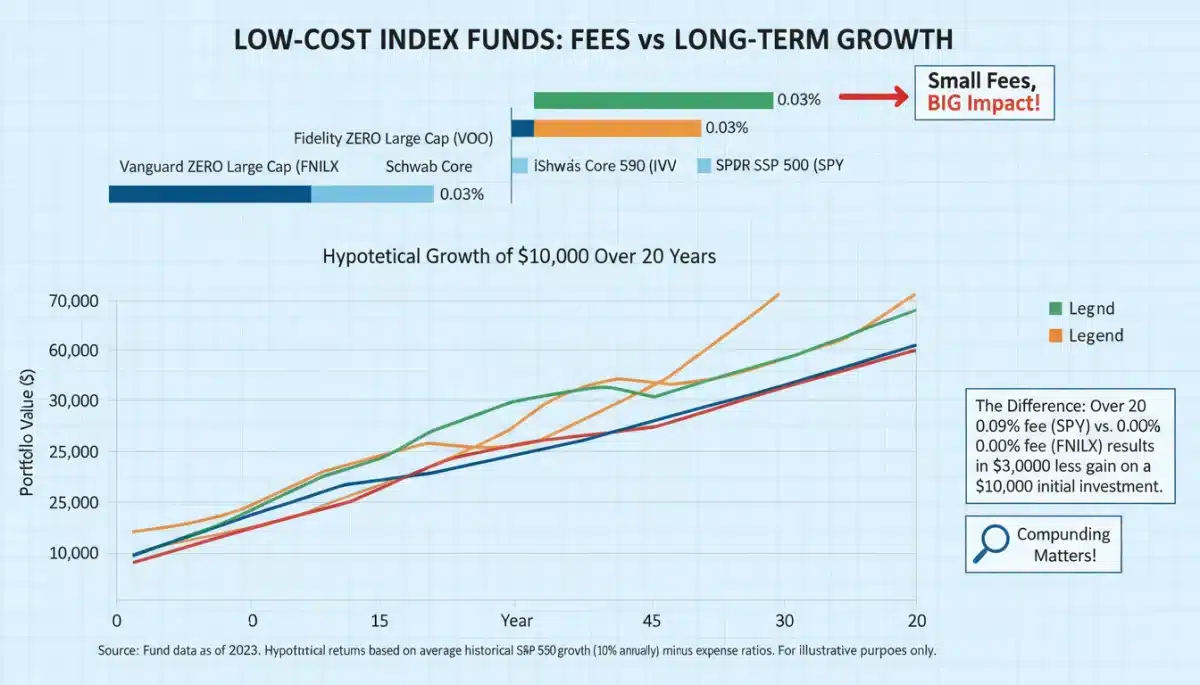
The expense ratio is the annual fee charged by the fund, expressed as a percentage of your investment. For index funds, this ratio is typically very low, often below 0.10%. A lower expense ratio means more of your money remains invested and compounds over time. Even small differences can lead to significant savings over decades.
- Impact on Returns: A 0.50% difference in expense ratio can translate to tens of thousands of dollars in lost gains over a 30-year investment period.
- Comparison is Key: Always compare expense ratios across similar funds tracking the same index to ensure you’re getting the most cost-effective option.
- Long-Term Savings: The power of compounding means lower fees have an amplified positive effect on your portfolio’s growth.
Therefore, prioritizing funds with the lowest possible expense ratios is a fundamental strategy for maximizing your net returns from index fund investments. This seemingly small detail can have a profound impact on your financial future.
Beyond expense ratios, tracking error measures how closely a fund’s performance matches its underlying index. A low tracking error indicates that the fund is doing an excellent job of replicating the index’s performance. Fund liquidity, particularly for ETFs, refers to how easily you can buy or sell shares without significantly impacting the price. High liquidity ensures efficient trading.
Finally, the reputation of the fund provider offers assurance about the fund’s management and stability. Providers like Vanguard, Fidelity, and Schwab are known for their investor-friendly practices and extensive range of low-cost options. Considering all these factors together provides a holistic view, enabling a choice that not only minimizes fees but also ensures a reliable and effective investment vehicle for 2026.
Top low-cost index funds for U.S. equities in 2026
For investors focused on the U.S. stock market, several low-cost index funds consistently rank among the best options for 2026. These funds offer broad exposure to the American economy, enabling investors to capture the growth of leading companies with minimal fees. Their enduring popularity stems from their simplicity, effectiveness, and strong historical performance.
Whether you’re looking for large-cap, total market, or sector-specific exposure, there’s a low-cost index fund designed to meet your needs. The key is to select funds that align with your long-term investment strategy and risk tolerance, ensuring diversified growth within your portfolio.
Large-cap market exposure
Funds tracking the S&P 500 are ideal for gaining exposure to the largest U.S. companies. They represent a significant portion of the U.S. stock market’s value and are often considered a benchmark for overall market performance.
- Vanguard S&P 500 ETF (VOO): Known for its extremely low expense ratio and broad diversification across 500 leading U.S. companies.
- iShares Core S&P 500 ETF (IVV): Another highly liquid and cost-effective option, offering similar exposure to the S&P 500.
- Fidelity 500 Index Fund (FXAIX): A mutual fund equivalent with a competitive expense ratio, often favored by Fidelity account holders.
These funds provide a solid foundation for any portfolio, offering stable growth potential by investing in the backbone of the American economy. Their low fees ensure that a greater portion of returns stays with the investor.
For those seeking broader exposure beyond just large-cap companies, total U.S. stock market index funds are an excellent choice. These funds encompass large, mid, and small-cap companies, providing even greater diversification. Examples include the Vanguard Total Stock Market Index Fund ETF (VTI) and the Schwab Total Stock Market Index Fund (SWTSX). These options ensure investors benefit from the collective performance of virtually every publicly traded U.S. company, further reducing idiosyncratic risks.
In conclusion, the U.S. equity market offers a wealth of low-cost index fund options in 2026. By carefully selecting funds that match your investment goals, you can effectively build a diversified portfolio that capitalizes on the strength and growth of the American economy while minimizing costs.
International and global low-cost index funds for diversification
Diversifying beyond U.S. borders is a crucial strategy for any robust investment portfolio, and low-cost international and global index funds provide an excellent pathway to achieve this in 2026. These funds offer exposure to developed and emerging markets worldwide, capturing growth opportunities that might not be available within the domestic market alone.
International diversification helps reduce portfolio volatility, as different regions and economies often perform differently. This lack of correlation can smooth out overall returns and enhance long-term growth potential. It’s about spreading your risk and widening your net for investment opportunities across the globe.
Developed markets exposure
Investing in developed markets outside the U.S. allows you to tap into economies with stable political systems and established companies, such as those in Europe, Japan, and Canada. These markets can provide consistent returns and act as a ballast against potential downturns in the U.S. market.
- Vanguard FTSE Developed Markets ETF (VEA): Offers broad exposure to large and mid-cap companies in developed countries ex-U.S.
- iShares Core MSCI EAFE ETF (IEFA): Tracks companies in Europe, Australasia, and the Far East, providing significant developed market diversification.
These funds are excellent choices for investors looking for stability and growth from mature international economies, ensuring a well-rounded global portfolio.
For those willing to take on slightly more risk for potentially higher returns, emerging markets index funds are worth considering. These funds invest in countries undergoing rapid economic growth, like China, India, and Brazil. While more volatile, they offer significant upside potential. The Vanguard FTSE Emerging Markets ETF (VWO) and iShares Core MSCI Emerging Markets ETF (IEMG) are popular choices, providing broad exposure to these dynamic economies.
Finally, global index funds offer a single-fund solution for worldwide diversification, often including both U.S. and international equities. The Vanguard Total World Stock Index Fund ETF (VT) is a prime example, providing exposure to thousands of companies across the globe in one convenient package. This simplifies diversification and ensures a truly global allocation.
Bond index funds: stabilizing your portfolio with minimal cost
While equity index funds are essential for growth, bond index funds play a crucial role in stabilizing a portfolio, especially as investors approach retirement or seek to reduce overall risk. In 2026, low-cost bond index funds remain a vital component for achieving diversification, income generation, and capital preservation with minimal fees.
Bonds typically offer lower returns than stocks but also lower volatility, providing a cushion during market downturns. Integrating bond funds helps create a more balanced portfolio, mitigating the impact of stock market fluctuations and offering a reliable income stream through interest payments.
Total bond market exposure
Total bond market index funds provide broad exposure to the U.S. investment-grade bond market, including government bonds, corporate bonds, and mortgage-backed securities. This diversification within the bond market helps spread risk and ensures a representative allocation.
- Vanguard Total Bond Market ETF (BND): A highly popular option, offering broad exposure to investment-grade U.S. bonds with a very low expense ratio.
- iShares Core U.S. Aggregate Bond ETF (AGG): Similar to BND, it tracks the broader U.S. investment-grade bond market, providing excellent diversification.
These funds are ideal for investors seeking a core bond holding that offers stability and income without the complexities of individual bond selection. Their low fees make them an efficient way to gain exposure to the bond market.
Beyond total bond market funds, investors might consider specific types of bond index funds to tailor their fixed-income exposure. For instance, short-term bond funds (e.g., Vanguard Short-Term Bond ETF, BSV) offer greater liquidity and less interest rate risk, suitable for those with shorter time horizons or who anticipate rising interest rates. Conversely, long-term bond funds (e.g., Vanguard Long-Term Bond ETF, BLV) carry more interest rate risk but can offer higher yields and greater sensitivity to interest rate changes, which could be beneficial in a declining rate environment.
Municipal bond funds (e.g., Vanguard Tax-Exempt Bond Index Fund, VTEB) are another option, particularly for high-income earners, as their interest income is often exempt from federal, and sometimes state and local, taxes. This tax efficiency can significantly enhance after-tax returns.
In summary, bond index funds are indispensable for a well-rounded portfolio in 2026. They provide essential stability, income, and risk reduction, allowing investors to navigate market cycles more smoothly while maintaining a low-cost investment approach.
Building a diversified portfolio with low-cost index funds
Constructing a diversified portfolio using low-cost index funds is a straightforward yet powerful strategy for long-term financial success in 2026. The goal is to combine different types of funds to achieve broad market exposure, balance risk, and optimize returns according to your individual financial goals and risk tolerance. This approach removes the guesswork often associated with active investing.
A well-diversified portfolio should typically include a mix of U.S. equities, international equities, and bonds. The specific allocation to each asset class will depend on factors such as your age, investment horizon, and comfort level with market fluctuations. The beauty of index funds is their ability to provide this diversification efficiently and affordably.
Asset allocation strategies
Determining your ideal asset allocation is the first step in building a diversified portfolio. A common rule of thumb is to subtract your age from 110 or 120 to determine the percentage of your portfolio that should be allocated to stocks, with the remainder in bonds. For example, a 30-year-old might have 80-90% in stocks and 10-20% in bonds.
- Core-Satellite Approach: Use broad market index funds as your core holdings (e.g., total U.S. stock, total international stock, total bond) and add smaller, more specific index funds or ETFs as satellites for targeted exposure (e.g., small-cap value, specific sectors).
- Target-Date Funds: For hands-off investing, target-date funds automatically adjust their asset allocation over time, becoming more conservative as you approach your target retirement date. These are essentially funds of funds, often composed of low-cost index funds.
Regularly reviewing and rebalancing your portfolio (typically once a year) ensures that your asset allocation remains consistent with your financial plan. This prevents one asset class from becoming disproportionately large due to strong performance.
When selecting specific funds, consider using a combination of the funds discussed earlier. For instance, a growth-oriented investor might allocate 60% to a total U.S. stock market fund (like VTI), 25% to an international stock fund (like VEA or VWO), and 15% to a total bond market fund (like BND). This simple yet effective mix provides broad exposure to global equities and a stabilizing allocation to fixed income, all with minimal fees.
Ultimately, building a diversified portfolio with low-cost index funds in 2026 is about adopting a disciplined, long-term approach. By focusing on broad market exposure, appropriate asset allocation, and minimizing costs, investors can significantly increase their chances of achieving their financial objectives without the stress of trying to beat the market.
Future outlook and considerations for 2026 and beyond
As we look towards 2026 and the years beyond, the landscape for low-cost index funds continues to evolve, but their fundamental advantages remain steadfast. Economic conditions, technological advancements, and regulatory changes will undoubtedly influence investment strategies, yet the core principles of diversification and cost efficiency offered by index funds are likely to endure as pillars of sound financial planning.
Investors should remain informed about potential market shifts and adjust their strategies accordingly, while still leveraging the benefits of these robust investment vehicles. The future promises continued innovation in financial products, but the simplicity and effectiveness of index funds are hard to beat.
Economic forecasts and market trends
While no one can predict the future with absolute certainty, staying abreast of economic forecasts and market trends can help fine-tune your investment approach. Factors such as inflation, interest rate movements, and global geopolitical events can influence the performance of various asset classes.
- Inflationary Pressures: Higher inflation might favor certain sectors or real assets, but broad market index funds are generally resilient over the long term.
- Interest Rate Environment: Rising interest rates typically impact bond prices negatively, making short-term bond funds more appealing than long-term ones in such scenarios.
- Technological Advancements: Growth in areas like artificial intelligence, biotechnology, and renewable energy could drive specific market segments, potentially making sector-specific index funds attractive for those looking to complement their core holdings.
It is crucial, however, to resist the urge to constantly tinker with your portfolio based on short-term predictions. A long-term, disciplined approach with diversified low-cost index funds is often the most effective strategy.
Regulatory changes are another area to monitor. While index funds have enjoyed a relatively stable regulatory environment, any shifts in taxation or investment product regulations could impact their attractiveness or structure. Staying updated through reliable financial news sources and professional advice is always recommended.
Furthermore, the increasing adoption of ESG (Environmental, Social, and Governance) investing principles is leading to a proliferation of ESG-focused index funds. These funds allow investors to align their portfolios with their values while still benefiting from the low-cost, diversified approach of indexing. As societal priorities evolve, expect to see more sophisticated and diverse options in this space.
In conclusion, the future of low-cost index funds in 2026 and beyond looks promising. While market dynamics will always present new challenges and opportunities, the core benefits of broad diversification, minimal fees, and passive management ensure they remain an indispensable tool for investors seeking to achieve market returns effectively and efficiently.
| Key Point | Brief Description |
|---|---|
| Low Expense Ratios | Minimal fees are crucial for maximizing long-term investment returns by allowing more capital to compound. |
| Diversification Benefits | Index funds spread risk across many securities, reducing the impact of individual company performance. |
| U.S. & International Exposure | Combining domestic and global funds enhances growth potential and reduces volatility. |
| Portfolio Stability | Bond index funds provide income and stability, balancing equity volatility in a diversified portfolio. |
Frequently asked questions about low-cost index funds
The main advantage is its ability to provide broad market exposure and achieve market returns with significantly lower fees compared to actively managed funds. This cost efficiency allows more of your investment to compound over time, leading to greater wealth accumulation.
Consider the fund’s expense ratio, its tracking error, the reputation of the fund provider, and how well it aligns with your investment goals and risk tolerance. Diversification across U.S., international, and bond markets is also key.
Absolutely. Their passive nature, inherent diversification, and minimal fees make them an ideal choice for long-term investment strategies, such as retirement planning, where compounding returns are maximized over decades.
Yes, many low-cost index funds specifically track international or global markets, including developed and emerging economies. These funds are essential for reducing home country bias and capturing growth opportunities worldwide.
Bond index funds provide stability, income, and reduced volatility, acting as a counterbalance to equity investments. They are crucial for creating a balanced portfolio, especially for investors nearing retirement or seeking capital preservation.
Conclusion
In conclusion, for 2026 and beyond, low-cost index funds continue to represent one of the most effective and accessible avenues for investors seeking to achieve market returns with minimal fees. Their inherent diversification, transparency, and passive management approach offer a compelling alternative to higher-cost, actively managed funds. By carefully selecting a mix of U.S. and international equity funds, complemented by bond funds, investors can construct a robust, diversified portfolio tailored to their financial objectives. The emphasis on minimizing fees ensures that more of your investment capital remains at work, compounding over time and significantly contributing to long-term wealth accumulation. Embracing these principles empowers investors to navigate the complexities of financial markets with confidence and efficiency.
Autor